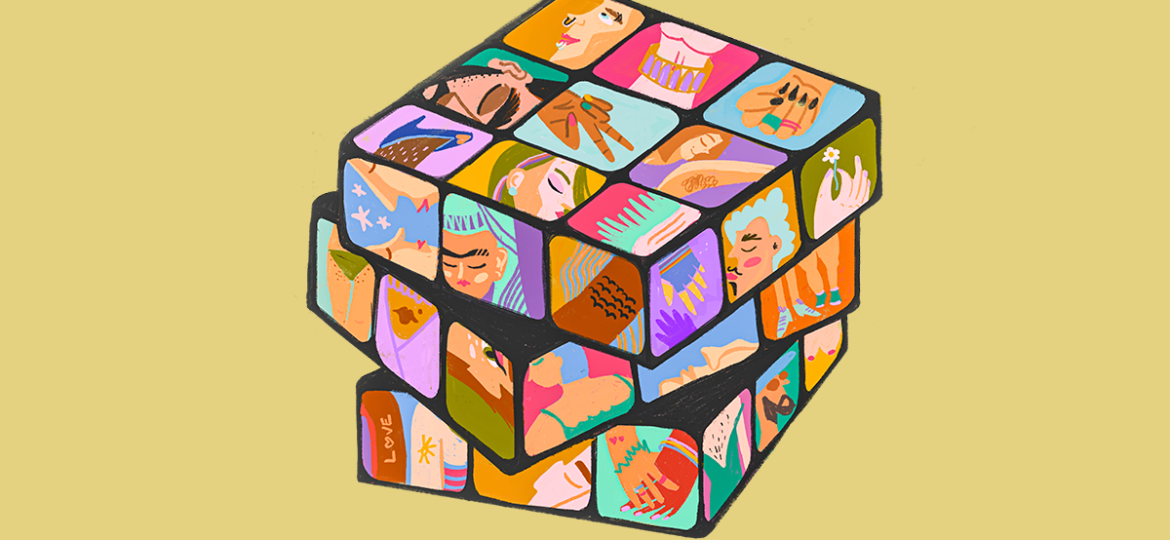
Masculinities broadly refers to the sets of attributes, behaviours, and expectations commonly associated with men or ‘male power’ in a given culture. With those very broad strokes, we could paint beautiful large canvases that glow richly with translucent colours spreading joy, vitality, and an abundant sense of wellbeing. However, in the current state of our world, the canvases are small, ill-proportioned and thickly layered with carelessly slapped-on murky hues; almost as if men, today, need to be shielded by thick dark crusts of the protections offered by newer and ever more curious forms of masculinities that are harmful to self and others.
Power. Violence. Ownership. Control. Brute force. Mistrust. If these are the ingredients, what do you get? Aradhana Phadke Sardesai takes us on a short but deep dive into the consequences of being fed a toxic soup, a soup poisoned by notions of men being entitled to control and own women, to denigrate respect and love, and to instigate and live by violence. Of course, not all men believe this or act in this manner, but the sad reality is that many do. Shaifila Ladhani posits that men perform a hollow identity, an identity that they do not fully comprehend and are not allowed to fully express, because they are forced to appear strong and to camouflage their vulnerabilities. Ergo, hyper-masculinity and the alpha male. This is not to excuse men as victims, but instead a call to look for a way that encourages men to feel real, and therefore, not hollow, to themselves.
Masculinities, as we know, are not the exclusive domain of biological males. Soumili Paul and Tiyasha Purohit take us to the realm of female masculinities as depicted in portrayals of Rani Lakshmibai and Chitrangada, and, more recently, in movies like Girlfriend and Geeli Puchhi. Unfortunately, as Soumili and Tiyasha illustrate, these more recent film portrayals pathologise and vilify female masculinities.
We have two contributions from students of the Goa Institute of Management who were assigned a project on crimes against queer men. A common crime they researched was of dating app scams. Namrata Dond and Vanshika Negi write up their findings and analyses of how queer men go looking for fun, but find trouble and fall prey to these scams. The many masks of masculinity contribute to this. Hardik Jain and Shrusti Mulgund present their findings through art and text that reveal the deep emotional and psychological impact of these experiences and the absolute lack of legal recourse these men have.
In our Reviews section, Pronita Tripathi writes about the multiplicity of masculinities in film-maker Vikramaditya Motwane’s works and highlights the anti-hero’s “quaint gentleness” in the film Lootera. Ambica Naithani, on the other hand, takes us into the darkness of Adolescence, the highly popular Netflix series, to show how large and sinister an influence the Internet is in shaping young boys’ ideas of what ‘being a man’ means.
Abhigya Singh offers us a breath of much-needed relief through her joyful discovery of Firdaus Kanga’s irrepressible resilience that shines through his book, Trying to Grow.
There are many ways of ‘being a man’ and Urasmita Ghosh tells us how Equal Community Foundation works with young boys to rewrite the script in order to create a society that is more gender equitable.
In Hindi, we bring you an original article by Imran Khan Najafi who makes a case for rethinking masculinity beyond its traditional and toxic forms, and a translation of Anne Sprinkel’s article on undoing entrenched ideas of masculinity in order to empower girls and women, and men themselves.
It’s time to scrape off the thick dark crusts of carelessly slapped-on murky hues of toxic masculinities and to bring out the brushes and the paints to paint masculinities in their true and glorious colours of life, freedom and love.
Go gently.
When dried hardened scabs are gently removed, they reveal the gifts of a process healing towards wholeness. Continuing with the theme of Masculinities and Sexuality, in this month’s issue of In Plainspeak, and writing with infinite care, beautifully and simply, Sudipta Das asks questions and uncovers truths that many are too frightened to approach, leave alone to touch. Sudipta questions not only masculinity but also gender, and their meanings and meaninglessness. Rumi Harish in an interview with Shikha Aleya, candidly responds to probing and nuanced questions about lived experience, looking at and challenging gendered systems, the writing of their autobiography, feminist politics, and a host of other fascinating issues.
What does questioning and challenging notions of masculinity mean in practice? How is it done on the ground? What happens as a result? Anand Pawar in a riveting account that moves easily between theory and practice, emphasises contextualising and localising this work. Through examples from the field Anand shows what it means to truly engage men and boys taking into account diversities of region, culture, religion, class and caste. Mariyam Sara and Nida Ansari do this through a powerful digital campaign and leadership journey with 40 young male ‘first-time’ influencers to create socially responsible content and narratives. Unsurprisingly, both Mariyam and Nida were not unaffected by this experience and learning and unlearning blossomed all around.
Moving to the zone of the more personal brings us, as always, to doubts and intimate questions. Asim Mudgal in questioning “How masculine am I?” wonders whether it is a muscled body, cultural identity, caste, or sexual orientation, that can provide him with an answer. Aranya Vadera analyses the alienation of trans-masculine lesbians in both trans-masculine and lesbian spaces because of dominant ideologies of sexuality and gender that play out even within queer communities.
Taarina Therese Chandiramani’s evocative short story, aptly titled Not Quite Anything, reminds us that sometimes not naming, not labelling and not explaining, are perhaps what are called for.
In Hindi we bring you three original articles and a translation. Naresh Kumar shares his personal journey from growing up with stereotypical notions and beliefs that foster masculinity to taking a stand against patriarchal norms. Imran Khan writes about how queer masculinity offers a challenge to traditional masculinities, embracing sensitivity, diversity and inclusiveness. Sakshi Nain Bishnoi’s two poems filled with haunting imagery expose the decaying core of rigid and inflexible masculinities. In translation, we have Saswati Chatterjee and Pauline Gomes’ article on how narrow notions and narratives of masculinities end up restricting men and everyone around them, but that, happily, change is in the air.
When no scabs remain, it’s a sign that the wound has healed. As many of our contributors to this issue have emphasised – the wounds are being exposed to fresh air, scabs are falling, it’s time for healing.
Go gently.
Cover image by Nanda Mentesheva on The Greats
