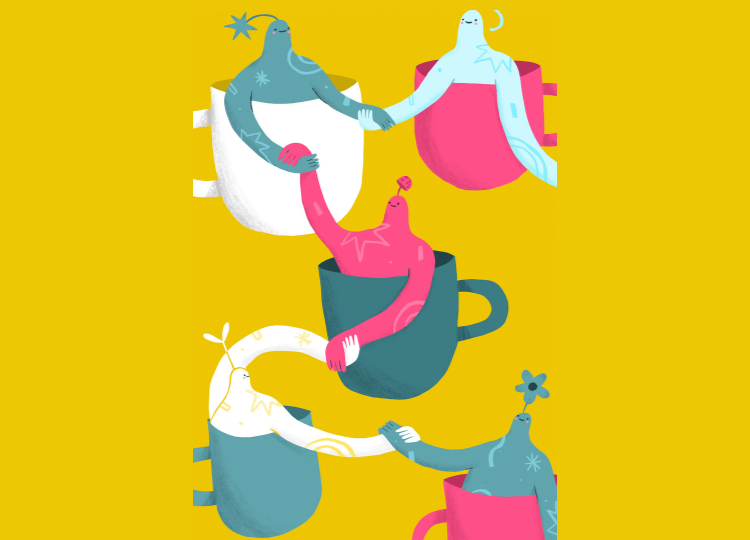
Friendship – a place where we can be ourselves as we truly are, with no artifice. A place of peace, leisure, enjoyment and affirmation. Where and how does friendship thrive? What sustains it? How does it intersect with sexuality?
Friendship doesn’t ‘just happen’ because we ‘click’ with each other. There are many factors that nudge us towards some people and keep us apart from others. Shikha Aleya intriguingly and effortlessly weaves together lions, langurs, caste, family, law, poetry, films and all manner of seemingly disparate factors to reveal how friendship and sexuality are, singly as well as together, far more complex than it appears at first glance.
So, what might bring us together? A government programme turned friendship-incubator? Greeshma writes about the friendships that rural Malayali women forge thanks to weekly neighbourhood meetings that nurture camaraderie, gossip, shared laughter and emotional intimacy. edamame and passionfruitdrizzle offer us vignettes into how their shared love for sensual play and taking and sharing sensual visuals led to a friendship that sustains them when the world feels too much. Andy Stephen Silveira tells us how in transient erotic encounters it is possible to experience authenticity and deep satisfaction.
Sonakhya Samaddar’s fiction piece takes us into a rent-a-friend territory with a twist at the end. A happy twist, don’t worry.
And if we are apart or parted from our friends, what then? Pronita Tripathi explores the tones and textures of the intimate friendship written about in Simone de Beauvoir’s The Inseparables. Carol Blaizy D’Souza’s poem is a love-letter to a friend and a city, both sorely missed and evoked through all the senses. Sanandita Chakraborty’s photo essay touches on friendship, loneliness, sexuality and longing.
In Hindi, Imran Khan writes about the power and possibilities that inclusive friendships create not just at an individual but also at a societal level. We bring you a translation of Ambica Naithani’s article about the strong friendships forged in college in an all-women space and how threatening these connections seem to men, and of Vanshika Gupta and Niv’s article about the inclusions and exclusions that queer people encounter while using digital platforms to form friendships and communities.
Whatever your friendships, be they online, offline, erotic, platonic, or any other flavour, may they be generous.
Friendships come in many guises, but their signature is always the same: You are important, you matter to me. November’s issue is a celebration of this truth.
In an interview with Shikha Aleya, Unmana, author of Chikkamma Tours (Pvt.) Ltd, talks about how they use the word ‘friend’ and what friendship means to them. Unmana’s book, featuring India’s first fictional queer detective, centres friendships between women. Speaking of books, Ambica Naithani writes about how books became her most trusted friends when she was trying to find her feet (as well as friends) in new cities and new schools, and how, now, she can count on both – friends of paper and friends of flesh.
Friends may be found in paper, in the flesh, in the workplace, in romantic relationships, in short, anywhere. It is we who make distinctions that limit where joy may be found. In a soul-baring article, Malavika Krishna Kumar, saying “ I have always been in love with my friends”, exposes the false separation between ‘friends’ and ‘lovers’ and introduces us to a new framework of thinking about relationships. Nandhini Jaishankar, who had earlier considered the workplace to be off-limits for friendship, finds that friendship in the workplace is an act of nurturance, allowing for shared vulnerability, growth, and collective hope. Tanvi Khemani takes us to another act of nurturance – a time-honoured ritual shared amongst girlfriends who discuss in detail every episode of their personal heterosexual dating dramas – the Debrief that lies at the heart of dating.
Friendship is not capitalism’s best friend; competition and rivalry are. Pop stars like Charli XCX, Ariane Grande, Billie Eilish, Taylor Swift, and others, are encouraged to feud. Instead, as Aradhana Phadke Sardesai shows, through acts of creativity and friendship they cock a snook at the capitalist and sexist music industry. As unlikely as it sounds, a government-run microfinance programme for rural Malayali women also acts as a friendship-incubator. Read the Hindi translation of Greeshma’s article about how shared laughter and gossip at weekly neighbourhood meetings lead to collaboration and emotional intimacy.
To round off this issue, Swetha U brings us three poems. Poems that echo the lines we began with: You are important, you matter to me.
May you always be held in the hearts of your friends.
Cover image by Pati Matsushita on The Greats
