I don’t know what to call this piece of writing – an essay, a fieldwork diary, or a journal entry? It’s at the discretion of the reader to put this in whatever category they like.
For me, it is an experience, a feeling, and a memory.
I want to talk to you about the women in my community, the very women I grew up seeing, the ones I look up to for love and resilience.
*
Last year, as part of my MA project, I spoke with women, married, older than me, in their early thirties to their seventies. As a 23-year-old researcher, studying them felt like studying my possible future.
Wait! My research was about women, leisure, and friendship – three of my favourite words put together. In the introduction of my thesis, I wrote, “…the potential of leisure and friendship as tools for empowerment, enabling women to challenge norms, build support networks, and redefine their identities within gendered landscapes.”
Talking to these women was the most joyful stage of the research. In the afternoons, we sat on the verandah and talked about life. For those two hours, I was, for all intents, their friend.
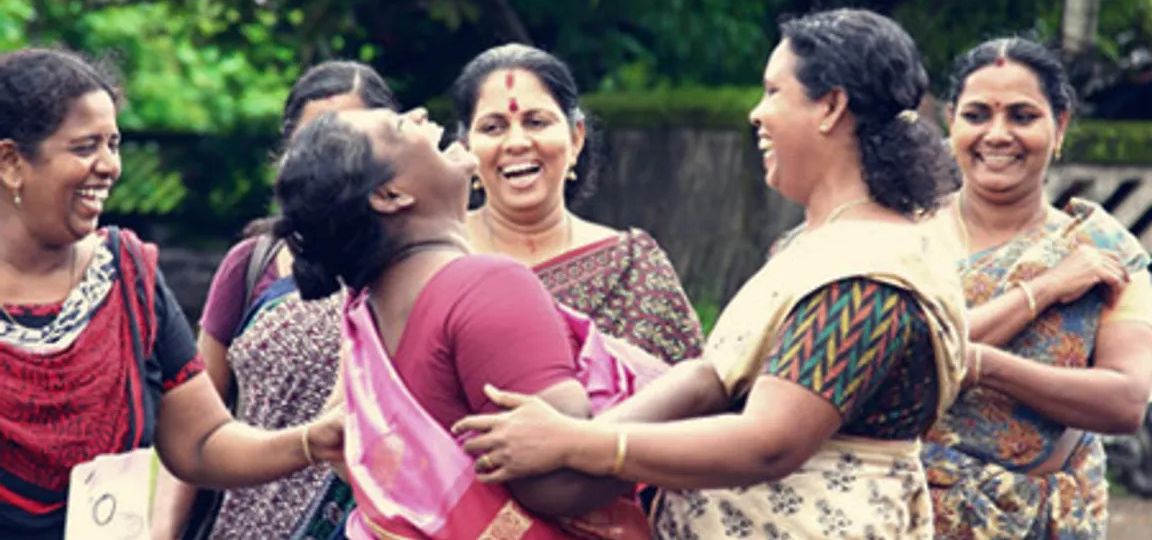
For rural Malayali women, the opportunities to form friendships look different from those in urban settings. Kudumbashree1 meetings on Sundays are something they all look forward to attending because that is their socially sanctioned chance to meet their friends. Even if Sundays mean extra work, women will somehow finish their chores and head out to their friend’s house in the neighbourhood. As children, we called those meetings ‘noisy spaces’ where women talked in loud voices in ways that sometimes disturbed the men taking Sunday afternoon naps. Small as they may seem, these gatherings are powerful.
My grandmother was a religious Kudumbashree member until a few years ago. After my grandfather died, she restricted her outings and gradually withdrew from the groups. Losing him also meant losing the weekly monetary contribution to the SHG.2 She then passed the routine on to her daughter-in-law, my mother, who is now active in women’s groups in the locality. As a child, I would often accompany my grandmother to these Kudumbashree meetings; my friends would also be there, coming with their mothers and grandmothers. It felt like a world within a world – weekly friends meet up. I could write a whole chapter on Kudumbashree as a focal point of friendship for rural women, but I will pause here.
*
Writers have celebrated women-women relationships throughout history. Adrienne Rich3 wrote about the “lesbian continuum”, highlighting how women’s bonds provide emotional nourishment, a safe space to share an “inner life”, and a source of strength against what she calls “male tyranny”. Eileen Green4 describes friendship as a consistent “thread” that links people across life transitions.
But how do these ideas play out in the everyday lives of women in my community?
In my conversations, women gained new friends at different phases of their lives – unlike their husbands, who often maintain the same childhood circle of friends. Marriage becomes an important turning point in women’s friendships because, when they migrate to their husbands’ homes, they often lose connection with their old friends. Though smartphones and the Internet now help, they cannot replace the physical intimacy of sitting beside a dear friend, holding hands, and sharing a cup of tea. “Those are the luxuries men have,” many told me – evenings in the village junctions and tea shops – daily male reunions. Spaces – public and private, physical and emotional – remain gendered even now.
For rural women, then, engagement sites tend to be within the boundaries of the neighbourhood. Family functions, festivals, weddings, and funerals become important occasions/spaces for them to meet and reconnect with friends.
Women often drop by their neighbours’ houses between their daily chores, borrowing oil or masala, or plucking papayas and moringa leaves. These interactions are usually short-lived, as the actors quickly return to their tasks at hand. Nevertheless, we must not downplay the significance of these moments, particularly within patriarchal cultures. They matter – small acts of connection that I would like to see as safe, powerful acts of defiance.
*
I was apprehensive about asking older women, “Do you have friends?” – women who are sometimes fifty years my senior. I tried using words like “peers”, “neighbouring women”, and “old schoolmates” instead of “friends”, but kept returning to “friends”. The only substitute for “friend” is “friend” itself. Irreplaceable, singular. Until then, I had assumed friendship was a male domain. Why did I think it wasn’t for older women? I was lucky to realise it is. As a sixty-year-old told me, “Your afternoons will be devoted to your friends to pass by and chat,” (until the hot conversation is interrupted by someone asking for tea at four).
In rural settings, women’s sexuality is policed in subtle and persistent ways, often under the guise of “care and safety”. Women shared how people still comment if they are seen with their hair loose. Those two short strands of hair falling onto either side of the forehead, escaping a long braid, mean disobedience. “Loose women is what they call us,” one said. Indisciplined hair, it seems, becomes a symbol of an undisciplined woman.
As one woman said, “I don’t have privacy even at home. My mother-in-law’s eyes roll when I shut my bedroom door and sit alone. Her tone then becomes uncomfortable.” Even within marriage, women’s sexual and emotional privacy is monitored, which extends beyond public spaces into the most intimate corners of domestic life.
*
Another central element in women’s friendship was gossip and humour. Women cracked jokes and teased one another – revealing a secretive version of themselves that appears only amongst other women – their ‘equals’. Gilligan’s5 work helps here: she explains how heterosexual relationships can reproduce dominance and subordination; same-sex friendships, by contrast, are often linked to greater emotional support and wellbeing for women.
In these conversations, emotional intimacy and openness came up repeatedly. One SHG member even said, “The main reason behind creating this group was to maintain our friendships and the bond we created during a training class.”
For many rural women, SHGs have provided rare opportunities for travel and sightseeing – to be away from home and routine. One of them sweetly recalled, “We stayed in a single room (during a trip), all of us together. We spent the whole night talking about things we never thought we would. We forgot to sleep and didn’t realise it was past six in the morning.”
It is in these friendships with other women that they find a rare freedom and intimacy, a space to move and express themselves without judgment. Here, they reclaim their right to self-expression, away from the gazes that often follow them at home or in public. In these circles, women offer life advice and gestures of self-adornment, receiving affectionate compliments and tight hugs in return.
As Rich rightly said, women’s relationships often exist on a continuum of love and desire /affection. They offer comfort that is emotional, sometimes even physical – a space to feel at ease in their bodies and (re)define who they are. While social norms still dictate silence around pleasure, agency, and intimacy, yet in these quiet, brief interactions, women weave small spaces of selfhood.
If I were to make a word cloud of these conversations with women about friendship, it would look like this: laughter, fears, support, healing, trust, solidarity, belonging, freedom, learning, and reassurance.
*
And yet, I am not naive enough to undermine the spells of patriarchy on them. A painful paradox emerged in the interviews. Some said, “Family is family. Friends are not. For me, my family is above anything else, and if they say no, it’s a no.” And to the next question, answering, “There is more happiness here (in women’s groups) than at home,” then adding, “I feel like we have something when we (women) sit together.”
Friendship, as they say, often ranks only second to their family – yet the joy and support they offer can be equally vital. It has taught some how to use the Internet, how to make informed decisions, how to save money, how to travel alone, and, above all, given them a space to be themselves.
That said, structures of power, like everywhere else, operate within friendships too. To look at gender as the only variable in friendship is incomplete. Like Sara Ahmed6 reminds us, there are social factors that decide who gossips, who speaks, and who is heard. I would like to believe friendships are spaces where power distributions are relatively equal, but they are never symmetrical as long as larger social structures exist.
Monster structures – they spare no one.
Even in the face of these looming forces, the friendships women forge – tender, witty and sometimes defiant – continue to grow.
Reference:
- Kudumbashree is Kerala’s poverty eradication and women empowerment programme. Operating through a vast network of neighbourhood groups, it facilitates microfinance and entrepreneurial activities among women. ↩
- Self-help group. Here, Kudumbashree. ↩
- Rich, A. (1980). Compulsory Heterosexuality and Lesbian Existence. Signs, 5(4,), 631–660↩
- Green, E. (1998). ‘Women Doing Friendship’: an analysis of women’s leisure as a site of identity construction, empowerment and resistance. Leisure Studies, 17(3), 171–185. https://doi.org/10.1080/026143698375114 ↩
- Gilligan, C. (1982). In a different voice: Psychological theory and women’s development (pp. xxx, 184). Harvard University Press. ↩
- Ahmed, S. (2011). Analysing women’s talk and gossip between two female friends. 3. ↩
Cover image by The Better India
