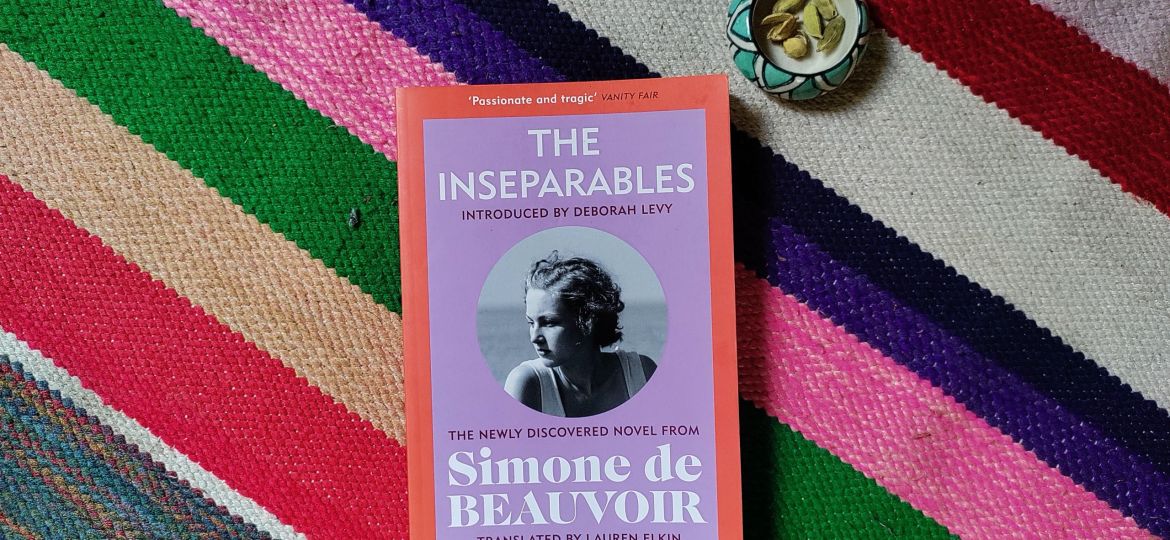
The intimacy and love that can exist within a friendship remains one of the most misunderstood and highly sensationalised terrains of human subjectivity. Moreover, in the case of women, intense friendships have always been viewed with a heightened suspicion – one of the many anxieties of an intrinsically patriarchal society. The above-quoted excerpt is from Simone de Beauvoir’s (1908–1986) posthumously published novel Les Inséparables; a fictionalised account of her real life friendship with Élisabeth Lacoin (1907–1929), fondly Zaza. The passage delves into young Sylvie’s (Simone) exceptional adoration for Andrée (Zaza) whose quaint oddities – bodily reactions to seeing or even hearing ‘peach’ or ‘orchid’ – are noted with great care and awe. This passage is fascinating not just because of the masterful ease with which Beauvoir captures the tenderness in an intense, coming-of-age friendship, but more so because at its heart lies the tragic realisation that no matter what, one can never fully understand another’s personality. Even though the duo is labelled ‘the inseparables’ by everyone, this realisation haunts Sylvie till the very end. The inability to understand Andrée and her untimely death culminates in the writing of this book – as Sylvie had predicted – both on Andrée’s intriguing personality and the unique adoration that blossomed between the two girls in early twentieth century France.
Although written in 1954, Les Inséparables was published 66 years later in 2020, followed by two English translations in 2021. The reasons for this delay in publication have often been blamed on Jean-Paul Sartre’s disinterest, however according to Sylvie Le Bon de Beauvoir (Simone’s literary executrix) the novel was not “what she wanted to do at the time”, thus Simone chose to move away from fiction towards autobiography (Willsher, 2021). Nonetheless, even in her autobiography, and later works, Simone kept writing about (and sometimes editing out) Zaza. Evidently, the twelve-year long, fervent friendship she shared with Zaza left an indelible impression on one of the most prolific writers and feminist thinkers of the twentieth century.
In this essay, I wish to explore the tones and textures of this intimacy which Simone and Zaza shared, reflected between Sylvie and Andrée in The Inseparables. Amid all speculations of Zaza being Simone’s lesbian affair, I want to pause for a second and ask – how constricted is our imagination of an intimate friendship? Must intimacy be tied to the sexual or is it allowed a course of its own? Can a caress exist on its own, without becoming the prologue to a carnal act? For instance, when Sylvie intently observes Andrée playing the violin, an urge to run her fingers through Andrée’s hair with “tenderness and respect” arises in her mind (94). This kind of touch seems to be sitting uncomfortably in uptight Victorian notions of female companionship and friendship. The radical possibility of physical and emotional intimacy without sexual ties and inclinations thoroughly unsettles and broadens the horizons of female friendships and shared solidarities.
Only those who have ever had pivotal female friendships while growing up would understand what Sylvie meant when she decided, “Life without her would be death” (16). Teenage female friendships are not easy and straightforward. They are often messy, overwhelming matters which stand us face-to-face with our first encounters with love, heartache, healing – they never completely leave us. The transition into this world of adult emotions is often marked by a bitterness: the longing for a return to innocence, with simultaneously rising curiosity and a discontent with familiar answers. It is within this complex emotional landscape that Sylvie and Andrée discover each other and seek, in their companionship, a momentary solace from the cruelties of growing up. Adrienne Rich in her influential essay has termed such “woman-identified experience” as ‘lesbian continuum’ wherein all women, irrespective of their sexual identity, keep “moving in and out of this continuum” (648, 651).
Apart from a relentless search for one’s own identity, these formative years are also marked by a need to be understood, which is arguably the same as being loved for one’s own sake. This is something which is central to Sylvie and Andrée, and is also seen in their real-life counterparts. In the selection of ‘Archive Material’ at the end of the novel is a 1927 letter to Simone, where nineteen-year-old Zaza writes – “There is no feeling in the world more sweet than knowing that there is someone who understands you entirely, and upon whose friendship one may count absolutely.” Thus emerges an interesting contradistinction between Sylvie’s failure to wholly understand Andrée, and Zaza’s claim that Simone did succeed in achieving precisely that. This fictional detour, I believe, is not a mere literary trope generating a tragic, lopsided account, but rather it marks a deliberate authorial decision to express the anxieties which accompany such intense friendships. When Pascal (Andrée’s lover) tells Sylvie – “‘I know Andrée as well as you…and even better, because I can follow her down paths from which you are excluded… Andrée has joys and consolations that you don’t know anything about” – it shocks her to the extent that she is unable to speak further and walks away (113-114). Moreover, one has to remember, this is an age wherein even questions on sexuality as well religion are considered taboo, blasphemous and deliberately kept out of bounds even in fictional conversations among close friends. Madame Gallard’s (Andrée’s mother) dictum aptly sums up the permissible aspirations of respectable ladies in that era: “Join a convent or get a husband; remaining unmarried is not a vocation” (58). It comes as no surprise that Sylvie and Andrée’s inseparable bond, intellectual pursuits and long discussions on adult matters were met with Madame Gallard’s stringent disapproval.
Such were the strictures of the age when one of the most radical feminists of the twentieth century found her first love, friend and sign of rebellion. In her last letter to Zaza, twelve days before her death, Simone writes, “I find happiness on every page, happiness in bigger and bigger writing. And I am closer to you now than ever before, my dear past, dear present, my dear inseparable friend.” How does one ever overcome the traumatic impact of losing such a friend at the age of twenty-one? And eventually, it is only through the act of writing – so ominously spelt out in this last letter – that Simone would grapple with Zaza’s loss. It seems as if in her act of writing, Simone found a way to stay inseparably tied to Zaza, bypassing death. The Inseparables is a reminder of the most ordinary ways in which a truly exceptional adoration and female friendship are born. Beauvoir’s beautifully poignant narrative is instructive in reemphasising the enormous importance of women’s intimacies and rich inner lives in shaping feminist historiographies and orienting oneself in an alien, overtly patriarchal world.
Reference:
- Beauvoir, S. de. (2020). Les Inséparables. L’Herne.
- Beauvoir, S. de. (2021). The Inseparables (Lauren Elkin, Trans.). Vintage Classics.
- Rich, A. (1980). Compulsory Heterosexuality and Lesbian Existence. Signs: Journal of Women in Culture and Society, 5(4), 631–660. https://doi.org/10.1086/493756
- Willsher, K. (2021, October 3). “My intimacy with Simone de Beauvoir was unique…it was love.” The Guardian. https://www.theguardian.com/books/2021/oct/03/simone-de-beauvoir-inseparables-sylvie-le-bon-de-beauvoir-daughter-interview
Cover image by Pronita Tripathi