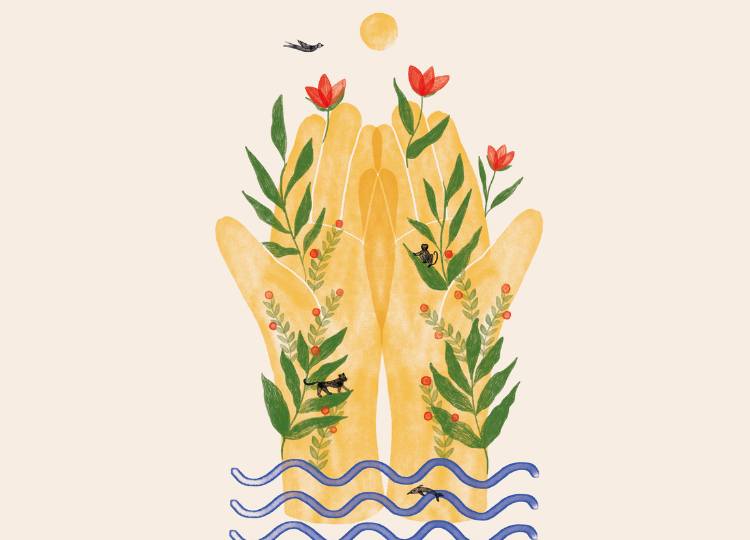
Climate change is not Earth’s retribution on humans and all other life forms but simply the consequence of the ways in which we humans have misused and abused the only planet we have. Floods, droughts, fires, storms and so on have always occurred but now they are occurring more often and with increased intensity. What does this have to do with sexuality, SRHR and wellbeing? Reetika Revathy Subramanian, in a many-layered interview with Shikha Aleya, responds to this and other questions with thoughtful and insightful answers backed by years of study, observation and practical experience. Reetika speaks about the links between climate change, sexuality, kinship, early marriage, livelihood, and gender inequality with a deep knowledge and political awareness of their complexities and nuances.
It is the complexities and nuances that policy makers overlook in their response to climate-induced disasters and their vision of climate justice. Bharati Takale Shukla, who has worked for over twenty years with sex workers, Dalit women and adolescent girls, writes about how climate policy often erases those living at the intersections of caste, class, gender, and labour.
Anahita Koshur, in a personal account based on the events of one single day, brings home to us how climate change affects sexuality, connection, mood and intimacy.
Lavanya Arora taking us into the space of poetry evokes images of ephemerality, fragility and strength all at once.
Abhigya Singh details the personal, intimate, private, deeply precious things that people lose to climate change and what climate justice really means in the context of sexuality. And Satbhan Singh shows, with examples of what the queer community in India has already done, how queer thinking can shape inclusive, humane and effective responses to crises.
Speaking of queer thinking, not in the context of climate change but of caste, Rohit Rajak offers us his musings and reflections on the recently published Queer Dalit Bahujan zine Across the Nala and nudges us to think in interestingly different ways about caste and queerness.
In Hindi, Imran Khan writes about how climate change affects sexuality, identity, rights and freedoms, especially for women, adolescents, LGBTQIA+ people and other marginalised communities.
Climate change is not only about the climate; it is about our lives, joys, connections, intimacies, pleasures, freedoms, and rights.
Step lightly.
That climate change is not only about the climate, but about all of our lives is quite clear. In our September issue of In Plainspeak this is brought home even more starkly.
Policy-makers and their grandstanding may have failed us, but fear not, there is hope as well. It comes from many sources.
Lakshmi Pillai Gupta brings us global and wide-ranging examples of hope and more – SMS midwives, e-clinics, chatbots, floating farms, climate apps. These amazing and effective grassroots innovations have been created by people living at the margins to meet the SRHR challenges their communities face on account of climate change. Lakshmi highlights that it is when those most at risk, and most affected, design solutions and technologies with care and local wisdom, that vulnerabilities turn into strengths.
We may not all be at the margins, but we are all at risk of being squashed by systems of control and misguided forms of ‘climate action’. Anvita Walia invites us to consider the truths we cannot always see, the limits that are drawn around us, and also our own often-unrecognised powers to gloriously and riotously upend these rules of so-called ‘order’, rules that would imprison and bend us to systems of domination.
Who gets hit the hardest? This is the question that Renuka Motihar tackles, bringing to life not only the consequences of climate change that affect the SRHR of many individuals and communities but also what can be done about it.
Urasmita Ghosh explains how teaching young people to challenge gender-norms can empower not just themselves but entire families and communities to deal with crises, including those wrought by climate change.
Alka Burnwal writes a heartfelt personal account linking climate change and discrimination based on skin colour in an interesting and unexpected way.
Taarina Therese Chandiramani takes us, through fiction, into what appears to be another time and another world, and leaves us wondering (with a lump in the throat) if it really is that far away.
From fiction we move to dreaming. And to how, with the right kind of philanthropic support, accompaniment and resources, some dreams do come true. And even if they do not, it is fine – because it is dreaming that is important. Read about the Human Capability Foundation’s bold initiative – The Dream Grants, the team’s motivations, the passion projects they have supported, and what they have learned along the way. We at TARSHI are immensely proud to be a part of the Dream Grants Project v.2.
In Hindi, we bring you one original and three translated articles. Imran Khan traces how climate change affects not only the environment but also mental health, sexuality and SRHR, and why they must be included if climate and disaster responses are to be effective. In translation we have: Abhigya Singh’s personal account of the intimate precious things that people lose to climate change; Bharati Takale Shukla’s article linking climate justice to sex work; and, Satbhan Singh’s article about the queer community’s humane responses to climate-induced and other crises.
Go gently. Keep dreaming.
Cover image by Silvana Pacheco Duncan on The Greats
