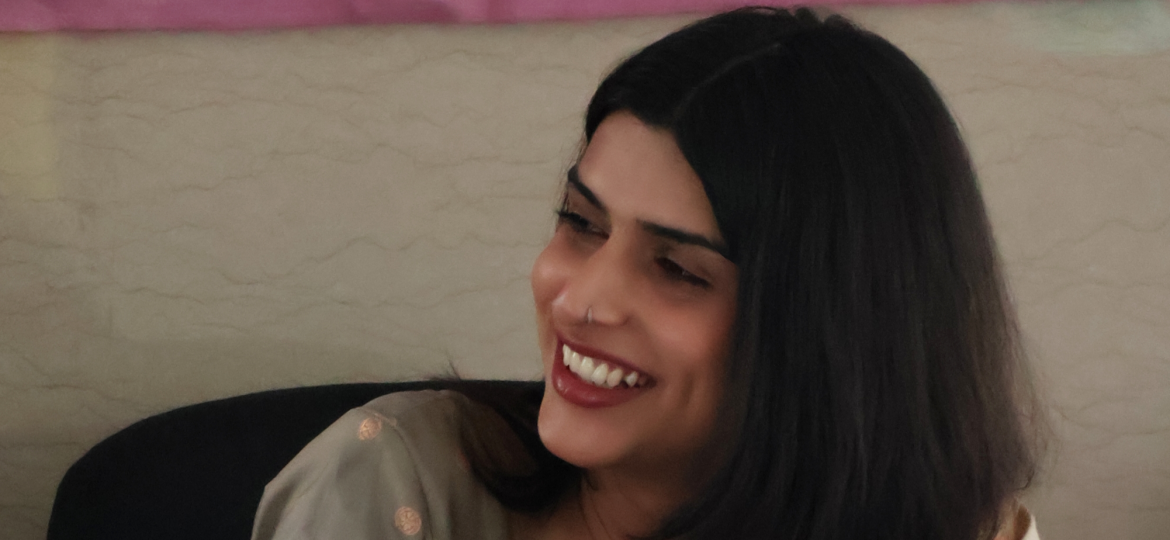
Raghavi S is a lawyer who identifies as queer, is a transwoman, and is one of the first members of the trans community to practice as a lawyer in the Supreme Court of India. Key areas of her work focus include Law & Policy, DEI and dispute resolution. Referring to her participation in an event at the Rainbow Literature Festival earlier this year, Raghavi highlights “the importance of centering empathy, inclusivity, intersectionality, cross-movement solidarity, and justice in our systems, structures, and narratives.” She is a recipient of the Lokmata Ahilyabai Holkar Mahila Samman – 2025 award, given as recognition to honour women awardees for their work in social activism, governance and multiple other areas of achievement.
Shikha Aleya (SA): Raghavi, a big thank you, we are very happy to interview you for this issue of In Plainspeak on Language and Sexuality. Jumping right in with the first question, when you think about the role of language in your life, what thoughts come to mind? How has language been part of your experience of your self and your identity?
Raghavi S (RS): Thank you so much, Shikha. It’s a pleasure. Language is fascinating and weird. For me, it has been both a site of struggle and a source of power. And when I think about language a little more, it becomes weirder. Because language has given so many wounds and scars to queer trans people, slurs and abuses – but then it can also heal. Lack of language to explain and express your experience, desire and being can be suffocating.
Growing up, I didn’t have access, like a lot of other queer folx, to the vocabulary that could hold the complexity of my gender or sexuality. I knew I was different, but I couldn’t name that difference. Knowing and naming matters not because it simplifies us, but because it allows us to be legible to ourselves and to the world. The unknown causes fear. A fear of one’s self as well.
In my case, the act of finding queer and trans-affirming vocabulary both in English and in the textures of my mother tongue, was like coming home to myself. I now see language as a site of resistance. I realised that the way we speak or refuse to speak can shape how we resist erasure.
So, for me, language isn’t just a communication tool. It’s survival, affirmation, and resistance. It is how I’ve learned to stake claim to space in a world that often writes people like me out of the frame.
SA: So beautifully, so well said, thank you. Raghavi, as one of the first transgender persons to be a practising lawyer in the Supreme Court of India, you are in a unique position to understand not just legal language, but the language of justice and enforcement as used on the ground. On the subject of sexuality and rights, what are your insights on how law and enforcement duty bearers use language to empower or to disempower individuals and communities?
RS: That’s such an important question. I often say that law isn’t neutral; it speaks, and the language it speaks with has deep consequences. Legal language is supposed to be objective and precise, but in practice, it’s deeply coded with power, and that power can either enable or alienate. Legal language is often wielded in ways that distance rather than connect.
In my experience, particularly as a queer and trans person navigating the legal system, I’ve seen how the very words used by law enforcement and courts can determine whether someone feels human or disposable. For instance, when a police officer insists on using someone’s deadname or refers to them with the wrong pronoun, it’s not a small slip. It’s a way of denying that person’s existence, their truth, and their dignity. And this happens all too often.
Even judicial language is not immune. I remember reading older judgments where transgender persons were referred to using dehumanising terms and it struck me how language, even (and especially) when couched in legal lingo, can inflict violence. Thankfully, this is slowly changing. The NALSA judgment in 2014 was a turning point not just because it recognised the right to self-identification, but because of the care with which it spoke of dignity, autonomy, and constitutional morality. The use of the phrase “third gender” I disapprove of, but what also stayed with me was the attempt to move away from silence and invisibility.
But that judgment is the exception, not the norm. On the ground, in police stations and district courts, language is often wielded as a tool of gatekeeping. People are told, “There’s no case here” when reporting sexual violence because their queerness is seen as deviance, not vulnerability. Trans women are frequently misgendered in custody records, FIRs, and medical examinations, and queer couples face ridicule when trying to file complaints about violence or forced separation.
Language in the law also creates hierarchies between those who “fit” the narrative of the deserving victim and those who don’t. The way law enforcement officers describe or interpret relationships between queer people often reflects their own discomfort. Sometimes, even just the refusal to say the word “partner” or “lesbian” or “transgender”, instead resorting to euphemism or silence, becomes an act of erasure.
At the same time, I’ve also seen how conscious shifts in language can create real change. I’ve been part of sensitisation trainings where we’ve discussed the use of respectful terminology, and you can see people begin to reframe their own biases. When a magistrate refers to a trans woman correctly, or a lawyer insists on affirming someone’s identity in court, it sends a signal that language can be a tool for solidarity, not just surveillance.
In the end, language is never just about words. It reveals whose lives are considered valuable, whose pain is considered real, and whose dignity is recognised. For queer and trans people, changing the language of the law isn’t just symbolic, it’s about survival. Change is slow, but not impossible.
SA: More on the use of language – in this interview available online, you have briefly spoken of family support issues from your perspective, being the only child of a single parent. Do you feel that there is a language that families use, especially parents and children, that is based on assumptions and expectations? How does this language-of-family include or exclude some people?
RS: Yes, absolutely. The language used in families is often built around assumptions about gender, duty, shame, and success, and these assumptions are rarely spoken aloud. But they shape everything. When a child is queer or trans, that language often becomes a weapon cloaked in care. In my own life, being raised by a single mother, I heard a lot of things like “You know how hard I’ve worked to raise you” or “Don’t bring shame to our name.” These aren’t just words, they’re instruments of control, used to silence you under the guise of love and sacrifice.
Families can bully without shouting. They can bully by using your vulnerabilities against you. reminding you of your financial dependence, your isolation, or your need for love – just to make you comply, to make you smaller. I’ve often felt that when I stood up for myself or expressed my identity, the response wasn’t direct rejection but a sort of guilt-laced silencing. The subtext was: “How dare you want more, when I gave you everything?” That’s not love. That’s a way to neuter your sense of agency.
For queer and trans kids, homes can become the first spaces of bullying, of policing, of trauma. We grow up believing family is where you are safest, but for many of us, that’s simply not true. Homes are where many queer children first hear transphobic slurs, where your body, voice, mannerisms are mocked, corrected, ridiculed. Where silence is imposed, and shame is woven into everyday conversations.
I say this not theoretically, but from lived experience. I was raised by a single mother. And despite everything she did for me, and all that I’m grateful for, she has still not accepted me. It’s not just that she disagrees with who I am, it’s also that she lacks, or refuses, the language that could even begin to understand me. Words like transgender, affirmation, gender dysphoria, or even joy in queerness – they are either dismissed as “Western ideas” or treated as threats to the identity she had imagined for me. There’s a real fear in many families that if they understand, they will have to change. And so, they retreat.
But amidst all this chaos what has really saved me, and so many like me, are the communities and chosen families we’ve built, people who affirm us without question, who see us without condition, and who speak a language of care, even when they’re still learning the vocabulary. If our biological families refuse to speak our truths, then we have every right to find and create families that will.
SA: Yes! Thank you for your time, and the generosity with which you have shared your insights. One last question. How can language, any language, become an enabler, supporting inclusion and empowerment across sectors? What can individuals and communities do in this context with the languages they use for work, play, entertainment and in other ordinary life settings?
RS: Thank you for asking this. I truly believe that language is one of the most intimate things we share with one another, more than bodies, more than time. It’s how we name the world, how we make meaning, how we let others know they exist and matter.
Language has never been neutral. It carries history, trauma, longing, power. And yet, it also carries immense potential for transformation. I often think about how much of queerness is about reclaiming language, taking words that were once used to shame us and turning them into flags, into poetry, into armour. Or even creating entirely new vocabularies for joy, love, family, and futures that don’t yet exist.
I also think that inclusion begins in the everyday. It’s not only about getting policies right, though that is important, it’s also about what words we choose in a WhatsApp group, in classrooms, on stage, in memes, at dinner tables. Every time we normalise pronouns, every time we choose to not joke about someone’s body or voice, every time we correct ourselves and move forward – we’re creating more breathing space. Language that is open, curious, and respectful becomes a scaffolding for belonging. As communities, we need to listen, unlearn, and build vocabularies that are rooted in care. Because language is not just about saying – it’s about showing up.
Language can be a home, or a weapon. We each have a choice to build room with our words, or to shut people out with them. I choose to build room. I hope we all do.
Cover image credit: Raghavi S.