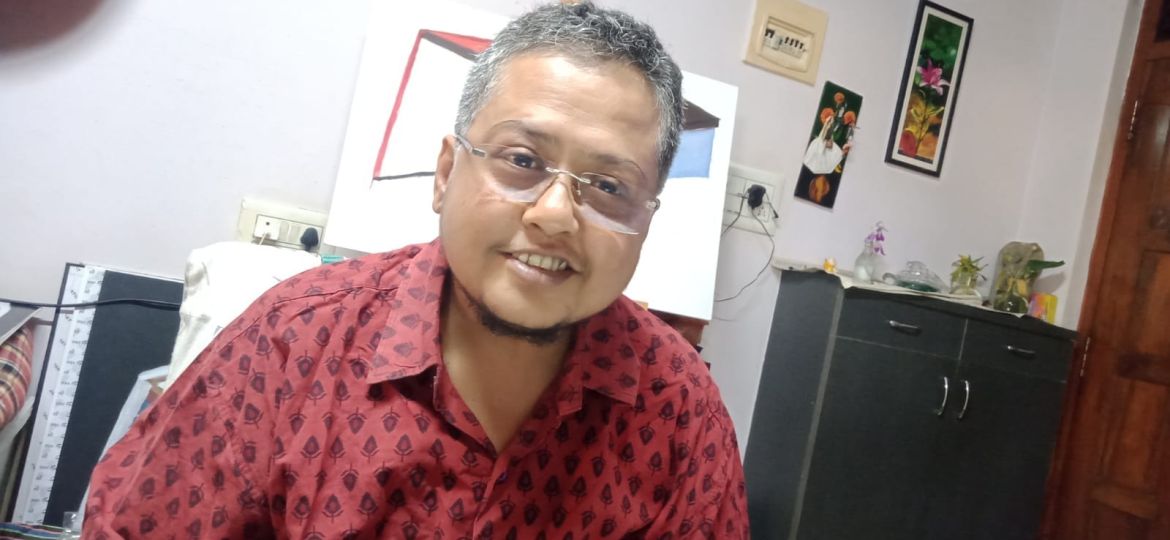
Rumi Harish is a musician, and a queer trans masculine and social justice activist. He is also a research consultant at Alternative Law Forum, a space that provides legal interventions and services, and a consultant on gender rights in Maraa Media and Arts Collective. Rumi has narrated Jounpuri Khayal, the first autobiography of a trans man in Kannada, published in 2023. It is written and composed by Dadapeer Jyman, a Sahitya Academy Yuva Puraskar recipient.
Shikha Aleya (SA): Rumi, thank you for being here with us, and for sharing your thoughts on the theme of masculinities and sexuality. The words ‘masculinities’ and ‘masculine’ generally bring socially constructed understanding, and pre-conceived notions of some normative, binary, traditional gender roles in life, relationships, work and play. Gender is individually experienced by each person, from the day that person is born and sex is assigned to them. In what ways does the idea of masculinity challenge or support the body and being, the life and relationships, of any individual?
Rumi Harish (RH): Masculinity, that word itself has a very negative connotation for me in my personal life. I feel that we should rethink this word probably, if we want to redefine masculinity. Somewhere, gender is a more comfortable word, because there’s a sense of what we are with gender, without having to define this as masculine or feminine, which is how patriarchy wants it.
In this whole process, I’m actually thinking very seriously in this discourse, why are we so hell-bent on masculinity? Again, the focus goes back to masculine men, cis men, their bodies, their issues, their egos, as if we are trying to challenge this to change the world. Yes, this is crucially important, but it is important that we challenge and look at gendered systems. And when we make it a gender discourse, or when we talk about new kinds of gender expressions, then we envision it in a different manner.
So for me, getting back to this whole discourse around masculinity, I’m also working on it, but I feel that it is limiting, because you’re only looking at one kind of gender expression. And through that, the kind of oppression that it has made, and then try to address it through that lens which intersects with caste and class and everything. But I still feel that that is probably only one way of looking at it. It is crucially important that we look at gender, how gender is constructed by patriarchy, how it is made use of for its convenience, whether in assigning bodies a certain gender or whether in defining the roles of a certain gender, because then are we going to separately study femininity? Are we going to talk about femininity in a different manner? No. I mean, I’m not saying the discourse is wrong or anything, I’m saying probably we can think a little more clearly if we use the term gender. And whether it is not just masculinity that is defined by patriarchy, it’s also femininity – and femininity starts reproducing the system at every single point.
We are all made to reproduce the system. We challenge it only when it comes to our personal issues. I mean, like when I have an issue with it, then I start questioning it, then I start challenging it. If it doesn’t disturb you in any which way, then you will really not question it. And if you question that, you are questioning that because at some point, at some level, in some manner, the system definitely disturbs you. Especially as assigned women or cis women, or even for that matter, people who identify as women. So I think that probably we need to reshape the structure itself, to redesign and relook at the idea of masculinity. Because the baggage of masculinity is a little too much.
SA: Thank you for that perspective. In your own life, you have stood up to be counted, shared your lived experiences as a queer trans masculine person, and spoken up against discrimination and injustice from a very personal space. What were some of the challenges you faced when working on your autobiography, ‘Jounpuri Khayal’? Were there moments that were difficult during the process – and what ultimately brings you satisfaction with visibilising your story?
RH: See, first of all, I was never excited about the idea of doing an autobiography. I think that’s a very single person story. So I had to work with the composer who was writing it for me, Dadapeer Jyman. We had a long conversation before we structured the autobiography. We decided that it won’t – it can’t – be a single person’s story. I’m not a person who has lived alone during any of the experiences. There were people. I mean, even when I was discovering my gender, there was my girlfriend. When I was discovering my gender, there were my parents. Then I was discovering whether I could really assert my gender or not, for like 30 odd years, because I was a classical musician. There were shit loads of people who actually wanted to support, or supported, or did not support – or somebody who kind of disliked the idea of what I was trying to say. There were people everywhere. So, for me, that process of living a certain gender or asserting a certain gender – for anybody I feel – is not a lone journey. You are constantly negotiating with everybody.
Dadapeer was very sensitive to this and finally, he came up with this idea of life in chapters – of people with whom I shared my life, like my mother, my father, my mother’s teacher, my music teacher, my friends, my partner and friend Sunil. So for me, I felt this life is ever-changing. And when you write autobiographies, you’re trying to take one box from one point to another point. But after that also we live.
It’s crucial that autobiographies be open, like how people are open and ever-changing. So, with Dadapeer we kind of decided what all will go into this kind of new writing of autobiographies.
In terms of accepting the challenges when answering the questions that he gave me – one was to relive my entire life while telling the story. The second is that sometimes a story looks and feels very different when it is occurring or when it has just occurred. But years later, when you look back and when you’re telling that story, that process brings a lot of reflection. It comes back with a lot of our own understanding and criticism. I feel that with Jounpuri Khayal, Dada has really taken up those aspects and has then written it, which is why I feel it’s a very open kind of a book. It’s flowing. It is not like a cut piece of my life from my childhood chronologically.
I feel that we do not live chronologically. We live in moments, and those moments are the things that we remember when we tell a story. Like when I first understood my gender, why I’m behaving like this. It is those moments that I still remember. I felt that a young writer like Dadapeer was generous enough to understand and respect my concerns.
And probably I’m reliving the same again. Even now, when I’m identifying as transmasculine, I’m still thinking – what am I expressing even when I say transmasculine? Going by my politics of feminism, how I got into feminism, how I started understanding patriarchy and after all that, if I still want to be a transmasculine person, then what kind of feminist politics am I into? And how am I living those forms of feminist politics? When I say transmasculine, do I suddenly get all the privileges of men? Which is what everybody thinks. But that’s not true. You are checked, day in and day out. So I think there is something more to it that we need to look at.
SA: You have given me a lot of food for thought here, as I am sure, others reading this will also experience. Coming to my next question, in this interview you have said, “I was pushed to live as her for almost 40 years as I did not have the strength to assert the Rumi inside me.” Would you say it is necessary for all individuals, across gender and across relationship roles, including parents, siblings, friends, partners, associates and others, to question and re-write prescriptions of masculinity? What does it take for a mother, a brother, or a partner in an intimate and sexual relationship, to rethink the meaning of masculinity?
RH: I don’t think this is a question of masculinity at all. This is a question of assertion of a certain expression inside you. I’m very clearly talking about the Rumi in me and the dead name person who was there, who was assigned female. There was a force, there was a pressure on me, because I was a musician.
I have learned Hindustani classical music for almost 40 years. There is a natural expectation that if you’ve learned it as a woman you need to continue doing things as a woman. Singing as a woman is quite claustrophobic because you don’t just sing as a woman, you are also made to live as a woman just because you sing. Especially singing classical arts. So to wear a sari, to be beautiful, to wear a bindi, all that very rotten kind of attitude, and that you have to appear in a particular manner. That’s not there for men – not to this extent. In this context, when I first broke it with gender-neutral dresses, my concerts started diminishing.
My assertion of my gender was not because of masculinity, it was because of the feminism which I practised – and that gave me this chance to come back to what I was. To assert what I was and to assert what I am. I’m choosing what kind of masculinity I want to live, not the run of the mill masculinity.
It was not masculinity about which I talked to my relatives or parents to accept me when I started expressing myself. It was feminism and it was probably the term femininity. It was an idea which came from several people – like whenever my mother would misgender me, immediately my friends would correct her. So that came from our shared trans histories and transgender feminism where we are very clear in terms of not hurting the people who are talking about this, or misgendering, but trying to say, “No it is not this, it is this”.
So masculinities need to grow. Masculinities, without much struggle like the women’s movement, just can’t take off in the name of feminism.
The history that feminism has put in, that gender has put in is not new. I feel that we need to relook even at terminology; just because there is a very fascinating new word let’s use it every day, no, that cannot happen. There is a history and there is a contribution of feminism, there is a contribution of gender, and that has to be acknowledged.
SA: Thank you for your insights and generous voicing of lived experience. You have lived life as a performer, a singer and musician, and this has been an integral part of your whole journey. As a last question, please share your reflections on inclusion and marginalised masculinities at the intersections of identities, such as caste, race, class, age, disability, profession, gender identity and sexual orientation.
RH: I look at your question in a different manner. The thing is, about marginalised expressions or marginalised gender expressions – you don’t know what expression is masculine, what expression is not masculine – and that comes back to performance. Because of a certain stereotype that has been assigned, things become masculine and feminine and things become transgender today.
I think we need to kind of go beyond these identity markers because the anti-caste movement, the disability rights movement, etc., they’re all still fighting in their own areas and these kind of identities have still not occurred to them to layer the marginalisation. Like what is happening in Karnataka is that they will say, “Dalit movement, women’s movement, and other marginalised movements”. So we are one of the “other marginalised movements” – but they don’t realise we are there in the Dalit movement, we’re there in the women’s movement, and that sexuality and gender as a movement has to be a part of other movements.
It cannot be a single-celled idea. So that way if you look at this, I feel that we are there, we’re not being acknowledged. We need to perhaps rethink in terms of – how do we get acknowledged? That is probably by extending the identities that we have – for example, I, trans masculine person, queer person, probably now I identify as gay, because I am attracted to men and transgender men. I am also a Brahmin but I was pushed out of the Brahmin familial support that I had because of my trans identity. But I cannot say I am not privileged.
I’m a person who is marginalised based on gender expressions. In general society, I get harassed or abused in public places because of my voice, because of the way I dress, because of my behaviour. Then so, if it is not I, if it is somebody else, then there are other identities like class – which class do I belong to, what amount of education do I have?
I think we need to break things down and then bring things together, only to say that these are all the identities. Which identity would I want to claim? Which identity would I want to keep for myself? I’ll choose it and then I have to make this identity complete and then decide how I’m going to involve myself in all the movements when I do this. Yeah, I think that’s the best way to be more inclusive.