Some stories are best shared from the soft shadows of memory, hidden behind laced curtains, sought through slightly ajar doors. They’re engraved into the quiet corners of the mind rather than living on the tip of the tongue.
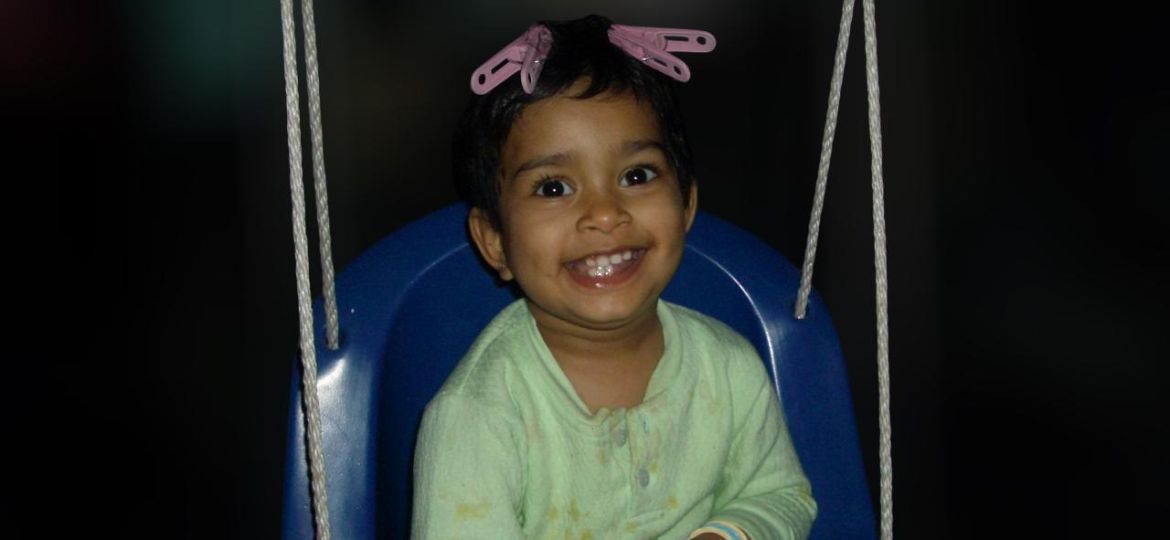
If you could peek into my earliest memories, you’d find a little girl curled up on a blue swing in her ancestral home in Mhow, taking in the warm, aromatic smells of old timber, sandalwood, and talcum powder, unaware of when she’d next smell that familiar combination.
Dadi, my grandmother, would prepare rumble tumble eggs and feed them to me straight from the pan. Her other hand would gently rock the swing with that special rhythm that only grandmothers seem to know – one push, one bite, one laugh. In the meantime, Dadu, my grandfather, would make up fantastical tales about animals from the jungle. It was during those moments that I first encountered a language composed of gestures and rituals rather than only words.
Dadu, once a young Sindhi boy from Lahore, spoke English with a crisp, dignified flair, honed in British-run schools before the upheaval of Partition. Dadi, born into a Goan Catholic family with Konkan roots, was schooled by globe-trotting nuns in a boarding school, where she recited the Rosary in flawless Queen’s English, but her Hindi, spiced with improvisation, was all her own. Together, they strolled through dialects and idioms, creating a language that was uniquely theirs.
On Saturdays, Dadi, dressed in vibrant magenta, butter yellow, or powder blue kurtas, led us down the narrow street to the town market, like a general guiding her troops. Dadu, checking that his wristwatch, the only accessory he cared about, was properly secured, would take my hand. I’d fall into step beside Dadu, the two of us trailing behind her like punctuation at the end of a colourful sentence.
“Bhaiyya, yeh baingan kitne ka?” (Brother, how much is this brinjal?) she’d ask, her Hindi sprinkled with innocence. Dadu would chime in with polished Urdu, “Daam sahi hai, bhaiyya?” (Is the price right, Brother?). The vendor, caught in their playful banter, would respond in amused Hinglish, “Yes, Baiji. Tomorrow, I bring fresh methi.”
Some days, we would wake up early to jump into the Army Club swimming pool while Dadi’s cheering reverberated off the tiled walls. Strapped into my little floaters, I bobbed at the surface, watching wide-eyed as Dadu climbed the diving board and leapt in, his splash sending ripples my way.
Back home, Dadi would give me a quick rinse in the tub with my squeaky ducky friends by my side. We’d then settle in and watch the Mr. Bean animated TV show. Dadu would conduct the theme song like he was facing an invisible orchestra. Every time, it was brand new.
Some mornings, we would enjoy the sun, and Dadu and I would sit and paint side by side. Words weren’t always needed – we were content in each other’s quiet company, letting stillness speak.
It took me years to realise that their home was my first classroom, and love was the language we spoke. Every evening, right at five, Dadu would get up, fill the old kettle, pour two cups of tea – always two – and bring them to Dadi. As a kid, I didn’t quite understand the significance of this ritual. But seeing her eyes light up as she would reach for her cup, I started to feel the depth of their unspoken love.
I didn’t know the term “soulmate” back then, but I understood that Dadu was Dadi’s Gullu, and she was his Annu. They are an embodiment of these names; they are now my Annu and Gullu. When Dadu passed, Dadi left his side of the bed untouched. She wakes up alone now, but her eyes continue to wander to that vacant side of the room as though she is biding her time until he returns.
There are dialects that no dictionary can contain. I learned then that some languages are woven from grief.
As I grow older, people often ask me, “Where are you from?” I’m never quite sure how to respond. My name itself is a polyphonic question that runs throughout many languages – remnants of Sindhi and Konkani, British phonetics, Portuguese prayers, Urdu couplets, and English essays. Having been raised by so many coordinates, how can I point to just one location on a map?
There is a constant yearning for fluency when one is a descendant of multiple lineages.
At church, the Goan community laughs in Konkani, their voices rising and falling in a lovely hymn. My Sindhi friends recite proverbs with ease, as though they were breathing. I suppress my words in the hope that I might at last find a sense of home in the melody of their voices.
My last read was Ocean Vuong’s On Earth We’re Briefly Gorgeous. His words are so tender; the truth I had never named. He says that language is a vessel that carries pain and love, a tool that can hide as much as it reveals. I, too, bear the scars and beauty of my ancestors. I understand how language can connect us and also set us apart, how it reflects queerness, identity, and the ache of longing.
Silence is just as much a part of language as words. Meaning is found in the spaces between sentences. The side of the bed that carries no weight. The tea that was made every day without fail.
Fluency, in my opinion, comes from living the language and emulating its unspoken dialects rather than from having flawless grammar. The quiet persistence of the relationship and the love I saw between Dadi and Dadu has its own language – one of endurance, sorrow, and devotion.
Maybe that’s why I write – to eavesdrop on the murmurs of memory, to conjugate the unspoken, to archive the dialects of love that lived between my grandparents’ silences.
I can still live in my ancestors’ languages, even though I don’t speak them well.
I’ve realised that language is not a barrier; it’s the bridge.
Cover image by Two Chandiramanis
