Gender

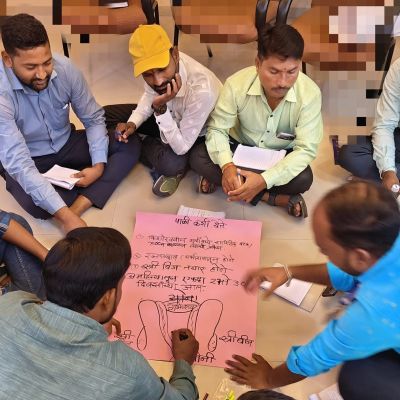
From Compliance to Critique: Localising Masculinity Work Through Feminist Praxis
…we must also address men’s relationships with their spouses, other men, women and children in the community, and importantly, their own emotional selves to transform fatherhood. Therefore, engaging with men as fathers must involve a holistic understanding of their socialisation, emotional world, and position within patriarchal structures.
By Anand Pawar

Friends of Paper, Friends of Flesh
That’s what books do, they open up the world to new possibilities, let you live a life bigger than your own.
By Ambica Naithani
November 17, 2025
Fragile Facts and Fearless Feelings
That little baby born in spring,
Shall “he” identify as Queer?
Regardless, Polaris feels queer!
By Khawahish
November 19, 2024
Forced into illness!
For long, a major section of our population considered people belonging to sexual ‘minorities’ as being mentally ill. They believed…
By Almas Shamim
April 1, 2015

June 15, 2026
Finding The Pleasure Point In Internet Policy Spaces
Someone called me a policy animal a few years back and I grudgingly agreed that indeed I’m one of those people who does get excited by the idea of influencing policy negotiations and policymaking
By Curated Content
February 17, 2020
Finding Lit’s Political Potentials
Fiction is often relegated to a secondary stow because fact-based forms of knowledge are becoming more and more valued. To be informed is to stay with the facts. Yet I think fiction allows us to stay just about as informed.
By Shweta Krishnan
March 2, 2020

Find Yourself – A Triptych
As we grow and experience intimate relationships, pleasure becomes taboo or is only okay as a performance for another person, rather than our right as human beings.
By Suryaa Rajan
November 19, 2024
Emotional Slaps: The Invisible Wounds of Patriarchy
Everyone talks about how nobody can put a price on how much homemakers do for us, but nobody talks about the kind of behaviour they are subjected to almost every day.
By Anuja Tripathy
November 19, 2024

Embracing Self
Why must others judge her appearance and grace
When true beauty is not confined to a face?
In a world obsessed with the outer shell,
She knows in her heart inner beauty dwells.
By Shruti Sharma
October 19, 2023
Editorial– Friendship and Sexuality
Friendship – a place where we can be ourselves as we truly are, with no artifice. A place of peace,…
By TARSHI
November 17, 2025

Editorial– CSE and Affirming Ecosystems
CSE’s ‘natural habitat’ is often considered to be the classroom, but as our contributors show us, CSE also lives, breathes and thrives in habitats as disparate as neighbourhood parks, jobs-training centres, playgrounds and sports fields, law schools, family discussions, and digital spaces.
By TARSHI
December 16, 2025

Editorial: Vulnerability and Sexuality
Vulnerability – is it a condition we find ourselves in? A state of being we choose? Let’s keep it very simple: it depends on the approach we take to defining it. In the former approach, we are ‘done to’, while in the latter we are consciously ‘doing’.
By TARSHI
April 19, 2021
Editorial: Mobility and Sexuality
In our mid-month issue, Mahika Banerji describing herself as being ‘massively function-less’ and as having ‘no mobility’, takes us into her world, not a world of sob stories but one that holds promise of fulfillment…
By TARSHI
August 13, 2019
Editorial: Literature and Sexuality
As we see through this issue of In Plainspeak, stories have in them the power of exposing brutal truths about society and therefore also bring with them the possibility of reform, change, and hope, and when not possible, temporarily escaping into other worlds.
By TARSHI
March 16, 2020