Voices

Of Mothers and Playgrounds
“City-living gave me talons and claws, but now I want to put those away. I want something else. I want softness. I want grass under my feet. I want the fist in my stomach to slowly unclench. I want the garden of my childhood to get lost in play while letting sunlit hours pass over to rosy dusk.”
By Sheena D'Lima
February 2, 2023
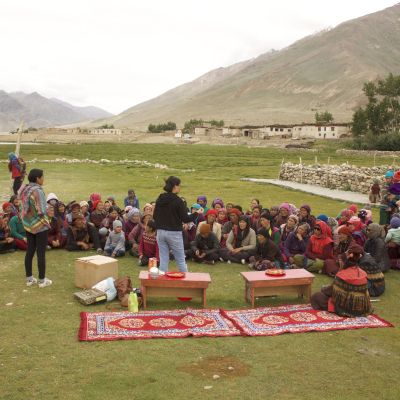
No More Closed Doors
Ladakh is famous for its beautiful mountains, big monasteries and unique culture and traditions. Thousands of tourists visit every summer…
By Tsewang Chuskit
February 2, 2023
Unscripted
She turns towards me when I speak, and I can feel her eyes thinking over my words, sensitive to any hint of criticism. Her thighs slide against mine, and for a moment we are both distracted by the naked coolness of our bodies. For a moment, we look at each other.
By Sami S
January 3, 2023
A Letter To My 16-Year-Old Self
You see, you are being pushed and pulled in all directions because people around you, whether family, friends or the larger society, expect you to behave in a particular fashion and stick to existing norms. However, your inner voice is telling you to challenge these norms and follow your own path.
By ElsaMarie D'Silva
January 3, 2023
Extra Large
“Large will not fit you.” / She is scoping me, up and down, eyes / Flicking fast and darting away…“Try extra-large instead.”
By Damini Kulkarni
January 3, 2023
A Space of Belonging
My sexuality had to somehow find people and a space to belong, just as my collaborators and friends needed something of that sort. We found this together in part with Matai Society.
By Kumam Davidson Singh
October 17, 2022
The many hues of connections
Connection, to my mind, is one of those profoundly entrenched concepts manifesting itself throughout our lives. It is difficult to let go of.
By Adsa Fatima
October 17, 2022
Where do we begin?
The connection between mental and emotional wellbeing and stigmatised identities is perhaps most easily understood and therefore a good entry…
By Shikha Aleya
September 19, 2022
When the Game is Set Against You, Why Play By The Rules?
“It is no measure of health to be well adjusted to a profoundly sick society.” — J. Krishnamurti Sexuality for…
By Simran Kewlani and Vasudha Ramani
September 19, 2022
The Chronicles of the Changing Room: Reclaiming the Cubicle of Doom
I pride myself on being a fast learner. Yet it took me an embarrassingly long time to realise that shopping,…
By Sanskriti Bhardwaj
September 19, 2022
Obedience, the Greater Good and Self-Exploration
I distinctly remember an adult male member of my extended family saying, “Cover up your chest with a dupatta. You…
By Taniya Mondal
September 1, 2022
Nightmares of Being Chased by an Angry Mob
My foray of offering support in both the fields of sexual wellness and mental health was unplanned to say the…
By Pooja Priyamvada
September 1, 2022
Queer mental health and therapy
In 2019, I was diagnosed with a chronic mental illness. “What is recovery and how do I find it?” was…
By Anuckriti Garg
September 1, 2022
High Heels and Loose-fitting Clothes: Movement Unfettered
As I reached puberty, well-meaning family members said that I should start being more ladylike; I believe that this is…
By Taniya Mondal
Shouldn’t The World Be Big Enough?
We live in a world where resilience is celebrated and given priority over attempting to resolve factors that force one to be resilient. Campuses shouldn’t aim to merely be inclusive of diverse individuals – they must strive to not only affirm them but also celebrate them.
By Mythili Menon
April 18, 2022