queerness


Quick Bytes with Taash
The relationship with my body is so fragmented that there’s not a primary “real” me, and that’s also how I locate queerness within disability.
By Taash
November 19, 2024

The Future is Femme
The patriarchy is petrified of gender fluidity. Not only does the femininomenon threaten the modes of sex-based binaries, but it also undermines sexist hierarchies.
By Sindhu Rajasekaran
October 17, 2024

Charting Queer Spaces: Lessons in Body and Belonging
Who gets to imagine this utopian sociality, or future, of the queer movement?
By Susmit Panzade
October 17, 2024
The Body at Work
It is evident that the workplace is not just a site for economic production but also a space where bodies are shaped, controlled, and violated.
By Shivani Rajan
September 18, 2024

The Role of Digital Platforms as Workplaces: Sexual Expression and Harassment in the Virtual Realm
Moving from the broader implications of the digital workspace it is essential to discuss specifically how these platforms influence the exploration of sexual identity.
By Yash Singh Sisodiya

Glass Onion
It was not uncommon for me to feel like an imposter, helping others connect with themselves while struggling to do the same myself.
By Janice G.
September 18, 2024
Editorial – Queering as a Way of Life
Queering is not about being queer but about doing queer – about going beyond binaries of gender and sexuality, questioning accepted perspectives, and challenging and upending normative ways of being in the world.
By TARSHI
July 22, 2024
Embracing a Queer Second Adolescence
To queer something is to disrupt normative frameworks, to imagine and create new modes of being (Pirani & Daskalopoulou, 2022)….
By Srividya Mehendale
July 22, 2024

Queering the Paradigm: Dismantling Politics, Power, and Privilege
Queering, as a theoretical and practical approach, has emerged as a powerful means of challenging and dismantling established politics, power…
By Lipun Kumar Sanbad
Video Corner: Queering as a Way of Life | An In Plainspeak Webinar
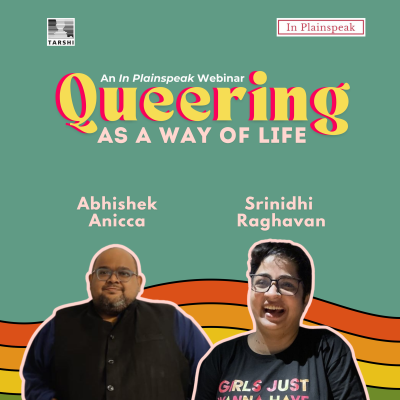
At TARSHI, we see queering as more than just an adjective; it’s a verb, an action that involves questioning accepted…
By TARSHI
Questions I want to ask!
If you’ve got a body, in which you’re going to negotiate this life, you have to know how it works.
By Suchitra Dalvie
June 18, 2024
A Queer Art of Longing
Like failure, longing is not interested in happy endings – whether of straight or non-heterosexual relations.
By Ketan Jain
June 18, 2024
Queer and Quarantine
How did isolation work for those of us who are already quarantined in perpetuity by the cis-heteronormative gaze?
By Raju Behara
June 18, 2024
A Journey of Unfolding
My identity unfolded slowly during my postgraduate media studies course, where I was exposed to peers from different socio-economic backgrounds.
By Apoorva Ravi
June 18, 2024

Making Space for Queerness in the Lives of Children
Queerness is a free-flowing identity that embraces anyone, including young children, who step off the assigned binary path.
By Riya Parikh
June 18, 2024